Posts

Showing posts from March, 2019

This American Life- quotes- Blog 7
Image
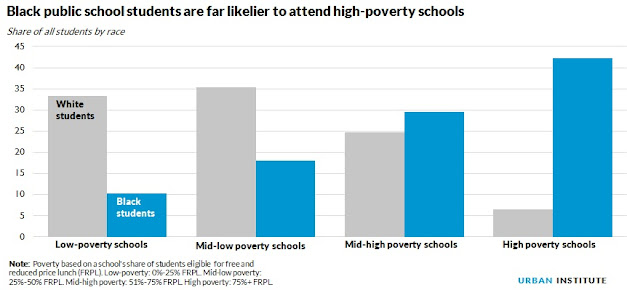
I really enjoyed listening to “The Problem We All Live With - Part One”. Even though segregation was outlawed, it is still very prevalent in today’s society. “The US Department of Education put out data in 2014 showing that black and Latino kids in segregated schools have the least qualified teachers, the least experienced teachers. They also get the worst course offerings, the least access to AP and upper level courses, the worst facilities. The other thing about most segregated black schools, Nikole says, is that they have high concentrations of children who grew up in poverty. Those kids have greater educational needs. They're more stressed out. They have a bunch of disadvantages.” (Ira Glass). Segregation in schools became outlawed in 1954, yet the above quote shows that schools are still being segregated sixty years later. Most schools with a majority of black students are poorer and more disadvantaged and there is no reason that should be happening. All children, regardles...

Kahne and Westheimer- Quotes- Blog 6

Image
“In the Service of What? The Politics of Service Learning” by Joseph Kahne and Joel Westheimer discuss how important community service is and the following three quotes show this. “Service learning makes students active participants in service projects that aim to respond to the needs of the community while furthering the academic goals of students” (Kahne and Westheimer). Service learning has the word learning in it for a reason. The participants learn from the community they are working with and that furthers their knowledge. Participants are not only helping others, they are also helping themselves. “These two service learning projects have much in common. Both provide authentic learning experiences, reflection on matters of social concern, and opportunities for interdisciplinary study linked to curricular goals. Moreover, the goals of both projects have broad-based appeal. They stress the importance of compassion for those in need, and they encourage children and young adults...

August- Hyperlink- Blog 5

Image
“Safe Spaces- Making Schools and Communities Welcoming to LGBT Youth” by Annemarie Vaccaro, Gerri August, and Megan Kennedy discusses how classrooms can be inclusive to youth who identify as LGBTQI+. The authors say that, “Sexual orientation topics are entirely absent from nearly half our elementary teacher education programs in the United States” (Vaccaro, August, Kennedy 85). When educators are not taught about sexual orientation topics, they can say things that are offensive or demeaning to the LGBTQI+ community and/or not teach their students about different types of people and families. This can lead to children feeling left out because of their sexual orientation or their home life, for example having two dads. An article I found, 12 Ways to Make Your Classroom Safe for LGBTQ Students ” by Kelly Huegel Madrone discusses different ways to make a classroom inclusive to all students, regardless of sexual or gender orientation. Madrone says some important ways to make your class...

Snow Day- "Unlearning the Myths that Bind us"

I watched the scene from Sleeping Beauty. The other movie I am analyzing is “Cinderella”. When I was in elementary school, whenever I stayed home from school sick I would watch “Cinderella” in my tiny carry around DVD player so I have watched it quite a few times. What is the moral of the story/take away message? For Sleeping Beauty, the takeaway is that true love's kiss can solve all problems. For Cinderella, the takeaway is that one person can solve all of someone’s problems (example: her fairy godmother, prince charming). Who is the main protagonist?  What is their race, ethnicity, gender? In Sleeping Beauty, the main protagonist would be Sleeping Beauty. She is white and a woman. In Cinderella, the main protagonist would be Cinderella. She is white and a woman. Who plays the servant or supporting character?  What is their race, ethnicity, gender? In Sleeping Beauty, the supporting characters are the three fairies, Flora, Fauna, and Merry...

Christensen- quotes- Blog 4

Image
“Unlearning the Myths That Bind Us” written by Linda Christensen was very thought provoking for me. The article discusses how our society teaches children from a very young age that people who are different from us are not “normal” and teaches young children to judge other people. “Our society's culture industry colonizes their [students] minds and teaches them how to act, live, and dream. This indoctrination hits young children especially hard” (Christensen 126). This quote sets the stage for the rest of the article and is very important. Christensen says that our society’s culture teaches young children how to dream and that is such a good point that I have never thought of. Children want to follow in the steps of the people around them and if the people around them are not having very different lives or careers, children will only know those few things the adults do. I think it is very important to expose young children to the outside world so they grow up without prejudices ...